Single-point aerial rigging: the two pulley systems, and what is safe with each

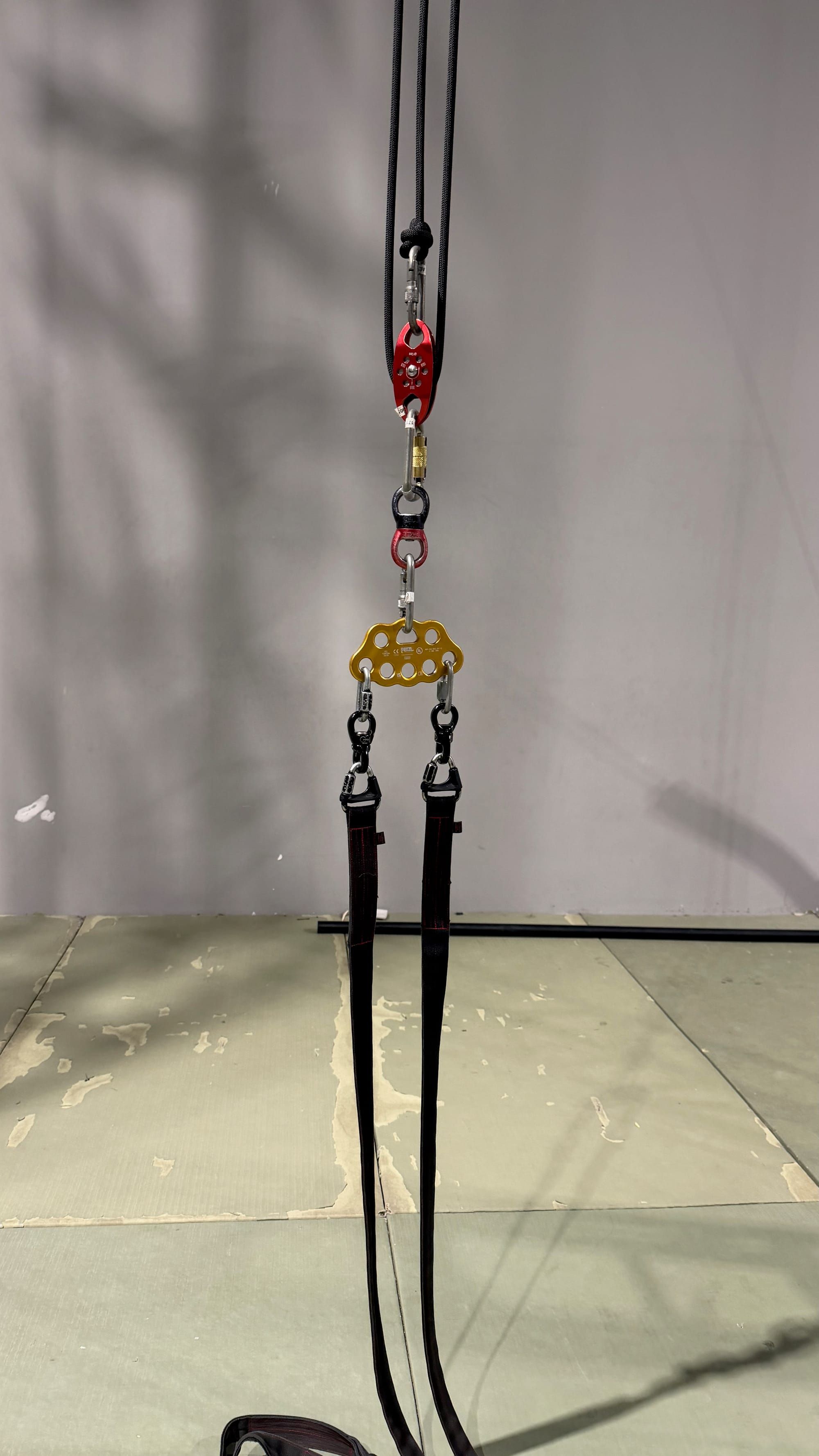
This article explains what happens when we hang aerial apparatus from a pulley system. This is a very common set up, however there are constraints to this method that you should be aware of.
For many silks, hoop or trapeze acts, the apparatus is hung from a point overhead supported by a pulley system. This is a safe method under most circumstances but there are cases where it is not, and the two common ways of building the system are not equally forgiving. This article walks through both, and for each one it says plainly what is safe to do and what is not, and why.
What the system actually is
When you watch someone fly on silks or a hoop, the apparatus hangs from one point overhead. The way it gets there is a rope-and-pulley system.
A rope runs from the apparatus up to the overhead point and through a pulley. The pulley lets us raise and lower the apparatus, swap one piece of kit for another, and set the working height. Once the height is set, something has to hold the rope there while the performer is on it. That holding job is done one of two ways:
- A figure-8 knot. The rope is tied off in a knot that locks the working position.
- An assisted-braking descender. A rope-lock device that grips the rope to hold the position, and lets the rope out under control when we want to lower.
There are also two ways to build the pulley part of the system, and the difference matters for safety:
- A direct system (1:1). One rope carries the performer's whole weight and runs up through a pulley or two and down to the lock-off.
- A shared-load system (3:1). The rope is threaded through several pulleys so the load is shared across three lines. This makes raising and lowering easier and, as you will see, changes where the force ends up.
The load the system has to take
Aerial is not still. A beat, a drop, a swing or a dislocation throws the force through the rope far above the performer's standing weight, many times their bodyweight, for an instant. A system rated only to hold a still person is under-rated for the real job. This spike is the force that everything in the system has to survive, and it is the reason the choice of holding device matters so much.
The direct system (1:1): what is safe, and what is not
In a direct system one rope carries the full load. That has two consequences you should know about.
The holding device is the first thing to get right. A figure-8 knot and an assisted-braking descender are not the same, and they are not backed up the same way.
- A figure-8 knot is a secure, positive hold. The knot itself is the hold. It cannot let go the way a device can, so a figure-8 is not backed up, and that is correct.
- An assisted-braking descender grips the rope and holds a still, standing performer comfortably. But aerial is not still. When the dynamic spike of a beat, drop, swing or dislocation throws the load past what the device can hold, the rope slips through it. A worn, wet or dirty rope lowers the point at which this happens, so it slips at a lower force than new, dry, clean rope. On a direct system the device is holding the full load, and that full load can exceed what the device holds. So on a direct system a descender must have an independent backup behind it: a second, separate means of holding the load if the device lets the rope slip. Never rely on a descender alone on a direct system.
The overhead point and its pulleys take more than you would think. A pulley does not just carry the performer's weight. Depending on the angle the rope turns through it, the pulley and the anchor behind it can carry up to twice the load in the rope. That is why the anchor and pulleys have to be rated well above the performer's weight, not to it, and why a strong-looking point is not the same as a rated one. In a direct system the pulley and the anchor behind it are the most heavily loaded parts of the whole set up.
So on a direct system: it is safe when the holding device is a figure-8 knot, or an assisted-braking descender with an independent backup behind it, and the overhead point and pulleys are properly rated and installed by a competent rigger. It is not safe when a descender is holding the load with nothing behind it, or when the point and pulleys were sized to the performer's standing weight rather than the much larger real load.
The shared-load system (3:1): what changes
Sharing the load across three lines does one very useful thing and leaves one thing exactly where it was.
What it fixes: the holding device now only has to hold a fraction of the load, because the rest is carried by the other lines. That fraction is well below the force at which an assisted-braking descender slips. So on a shared-load system the slip problem of the direct system is solved.
What it does not fix, and this is the trap: sharing the load makes the device's job easier, but it does not make the overhead point's job any easier. The performer still weighs what they weigh, and that full weight, plus a share for the pulleys, still goes into the overhead point. The anchor has to be rated exactly as strongly as it would for a direct system. Anyone who relaxes the anchor because "the load is shared now" has misunderstood what is shared. The device load drops; the anchor load does not.
What it costs: a shared-load system uses more pulleys, more rope and a more complicated thread. More parts means more to inspect, more to get right, and more ways to rig it wrongly. That added complexity is itself a hazard.
And the backup behind the device still stays. On a shared-load system the device is no longer likely to slip, but the backup now guards against the other things that can go wrong in a more complicated system: a part failing, a pulley threaded wrong, the device not gripping. The backup is cheap and it stays either way.
So on a shared-load system: it is safe when the anchor is rated as strongly as for a direct system, the extra pulleys and rope are all rated and correctly threaded by a competent rigger, and the backup is kept behind the device. It is not safe when someone treats the shared load as a reason to under-rate the overhead point, or when the extra complexity hides a threading or component mistake.
The wrong signs to watch for, whichever system
Whichever way the system is built, the same failures make it unsafe:
- A descender holding the load on a direct system with no backup behind it. The single most important thing to check. The device can let the rope slip, and if nothing is behind it the performer moves.
- An under-rated overhead point. A point sized to the performer's standing weight, not to the much larger real load. On a shared-load system, an anchor that was relaxed because the load is "shared."
- Unknown or unrated kit. A rope, pulley, anchor or connector that nobody can tell you the rating or the history of. Equipment with no paperwork is equipment you cannot trust under load.
- No inspection. A system nobody has checked before the performer gets on it.
- An improvised, unengineered point. A point in a ceiling, a beam, a climbing-frame, a tree. None of these are an aerial point until a competent rigger has assessed and rated them. Strong-looking is not rated.
What to trust, and what to watch for
If you fly, teach, hire a space, or send your child to aerial, here is what to look for. You are not expected to inspect a system yourself. You are expected to know what good looks like.
- Use a qualified, competent rigger. The single most important thing. "Competent" here means trained and experienced, not simply confident. A trained, experienced rigger is the foundation everything else sits on.
- Ask whether the equipment has a history. Rated, traceable kit with an inspection record is what you want. Equipment with no paperwork and no known history is a warning sign.
- If a device holds the height, ask whether it has a backup. A figure-8 knot lock-off is itself the secure hold, so there is nothing to back up there. An assisted-braking descender can let the rope slip, so on a direct system it needs an independent backup behind it, and the backup is kept on a shared-load system too. You do not need to know how the backup is made to ask whether one is there. It is a fair and sensible question to put to anyone rigging an act.
- Watch for the obvious wrong signs. Frayed or damaged webbing or rope, makeshift fixings, hardware that looks home-made or improvised, a setup nobody present can explain or stands behind. If the person running the space cannot tell you who rigged it and that it was checked, that is the signal to stop.
What you are checking for is whether the person who built it knew what they were doing and can show that they did.
Want the engineering behind this?
This article is the plain-English version. If you are training to be a rigger and you want the technical depth, the actual forces on every part of both systems, the factor-of-safety calculations, the device and backup specifications, the standards and the test data, that level sits behind the paid membership on circusrigging.info. The members' article on single-point rigging works through both the direct and the shared-load systems element by element, with the full worked numbers, and shows exactly where the force concentrates in each. Everyone else has what they need here: know what makes a point safe, use a competent rigger, and never settle for a system nobody can stand behind.
Sources and further reading. The facts in this article are drawn from the Aerial Edge Rigging Knowledge Base page on single-point aerial rigging, which is built from the European standards for rope and rope-adjustment devices, published aerial load research, and the safety duties under the Lifting Operations and Lifting Equipment Regulations 1998 (LOLER). The specific figures, device data and calculations behind these principles are set out in full in the members' article.